




PRACTICAL SELECTION GUIDE
Integrated or external hot tub stove – which one to choose?
Wood-fired stoves can reliably heat an outdoor hot tub, but they differ in their footprint, installation, and maintenance. An integrated stove is hidden within the tub's structure, while an external one is placed nearby and connected with water circulation pipes.
In this guide, we compare the most important differences and help you choose based on your hot tub, usage intensity, and maintenance needs.
Short answer
Integrated most often chosen when a compact exterior and seamless tub design are important.
External usually wins when you want to save more space inside the tub and have easier access to the stove.
There isn't one best option for everyone. The right choice depends on the specific project.
MAIN DIFFERENCES
Integrated and external stove in one comparison
Integrated bathtub stove
Advantages
- Compact and seamless tub exterior.
- Less space is needed next to the hot tub.
- The stove is integrated into the overall tub structure.
- A neat solution for a newly designed hot tub.
Disadvantages
- The construction takes up part of the interior of the tub.
- Access for repair or replacement is usually more complex.
- Integration is best planned during the manufacturing stage.
External hot tub stove
Advantages
- More space is saved inside the hot tub.
- Easier access to the stove and connections.
- It's usually easier to maintain, repair, or replace.
- It's convenient to adapt to an existing tub if the structure allows it.
Disadvantages
- You need extra space next to the hot tub.
- Hot surfaces and the chimney must be properly separated.
- Water connections and the stove itself.
How to choose the right option?
01 Vieta
If the most important thing is to save as much space as possible for swimming, an external stove is usually more convenient. If there is little space around the tub and a new project is being created, it is worth considering an integrated solution.
02 Care
An external stove is usually easier to access for inspection, cleaning, and repair. This is a significant advantage for rental businesses or intensively used hot tubs.
03 Installation Stage
It is best to plan for an integrated oven when designing a new hot tub. An external model is often easier to adapt to an existing hot tub, but it is necessary to consider the height of the connections, water circulation, and a safe installation location.
04 Usage intensity
Both options can work for a private hot tub. For country houses and rental projects, quick access to the stove, simpler maintenance, and the ability to replace individual components are often more important.
Which oven heats water faster?
The location of the stove alone doesn't reliably tell which hot tub will heat up faster. The heating time is determined by Stove power, water volume, tub insulation, thermal cover, outdoor temperature, firewood quality, heating intensity, and proper water circulation.
Therefore, when comparing models, it is more important to evaluate the entire system rather than just the words „integrated“ or „external.“ With properly selected power and installation, both ovens can operate efficiently.
Important for security
Both types of stoves must be installed in accordance with the manufacturer's requirements. A stable base, safe distances from combustible materials, a suitable chimney, and protection against touching hot surfaces must be ensured. Children and pets should not be left unsupervised near a lit stove.
Ignite Recommendation
Built-in oven When designing a new hot tub, you want a seamless exterior and can allocate part of the interior space for the stove construction.
Outdoor oven choose when it is important to maximally preserve or protect the interior of the tub, to easily access equipment, and to more easily maintain or replace it in the future.
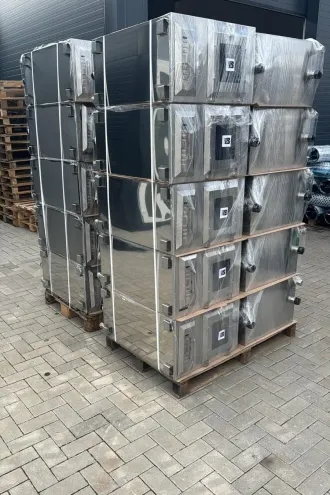
IGNISTA manufactures stainless steel hot tub stoves and can help you select the design, power, and steel type for your specific project. Read more about our manufacturing on the „About Us“ page“.
Stainless steel grade AISI 304 or AISI 316 is used for furnaces. Due to molybdenum, grade 316 steel is generally more resistant to pitting corrosion caused by chlorides, but the material must be chosen according to the actual water treatment and usage conditions. More information on stainless steel corrosion resistance can be found World Stainless information.
Frequently Asked Questions
Don't know which stove will fit your hot tub?
Tell us the size of the tub, its construction, how often it will be used, and the water maintenance method. We will help you choose the right type of heater, its power, and the grade of stainless steel.